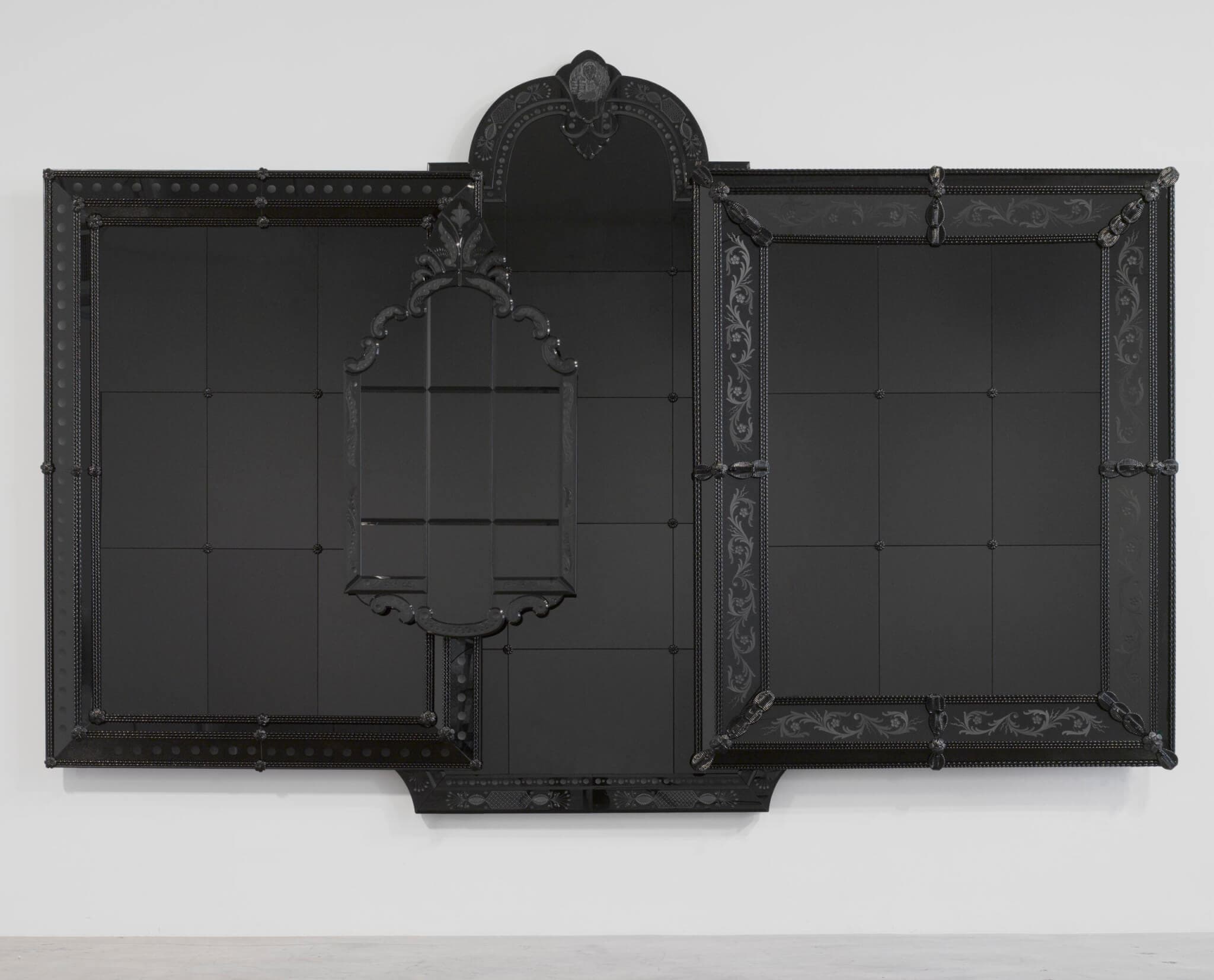
Straight ahead from the entrance on the back wall of a gallery in the Rose Art Museum is the massive black mirror Act V. Scene II – Exeunt Omnes (2014). Like several of Fred Wilson’s works, the piece references Shakespeare’s Othello. The wide monochromatic mirror drew me toward it, as if nearness might clarify the indistinct image being reflected, but to no avail. Like the titular stage direction exeunt omnes (exit all), the mirror ushers out any clearly defined image of what it reflects.
“Fred Wilson: Reflections,” organized by chief curator Dr. Gannit Ankori and on view through January 4, 2026, is Wilson’s first museum survey in over a decade. It explores how the renowned conceptual multimedia artist queries the meaning of Blackness in all its varied presences. Using a research-based approach, Wilson unearths hidden histories that speak to how institutions, monuments, archives, and even retail stores influence understandings of race and social and political life as well as history and culture. He is known for representing, presenting, and juxtaposing objects in ways that point to what should have been obvious but has been somehow obscured. As a whole, the show evinces the fervor of his artistic thought and practice.
Three sections organize “Reflections” in the Lois Foster Gallery and Stairwell. The first revisits works Wilson made for the 50th Venice Biennale in 2003 and related glass-blown works; the second debuts the immersive conceptual art installation Black Now!; the third presents a series of Flag paintings along the stairwell wall, partially visible through the window from outside of the Rose.
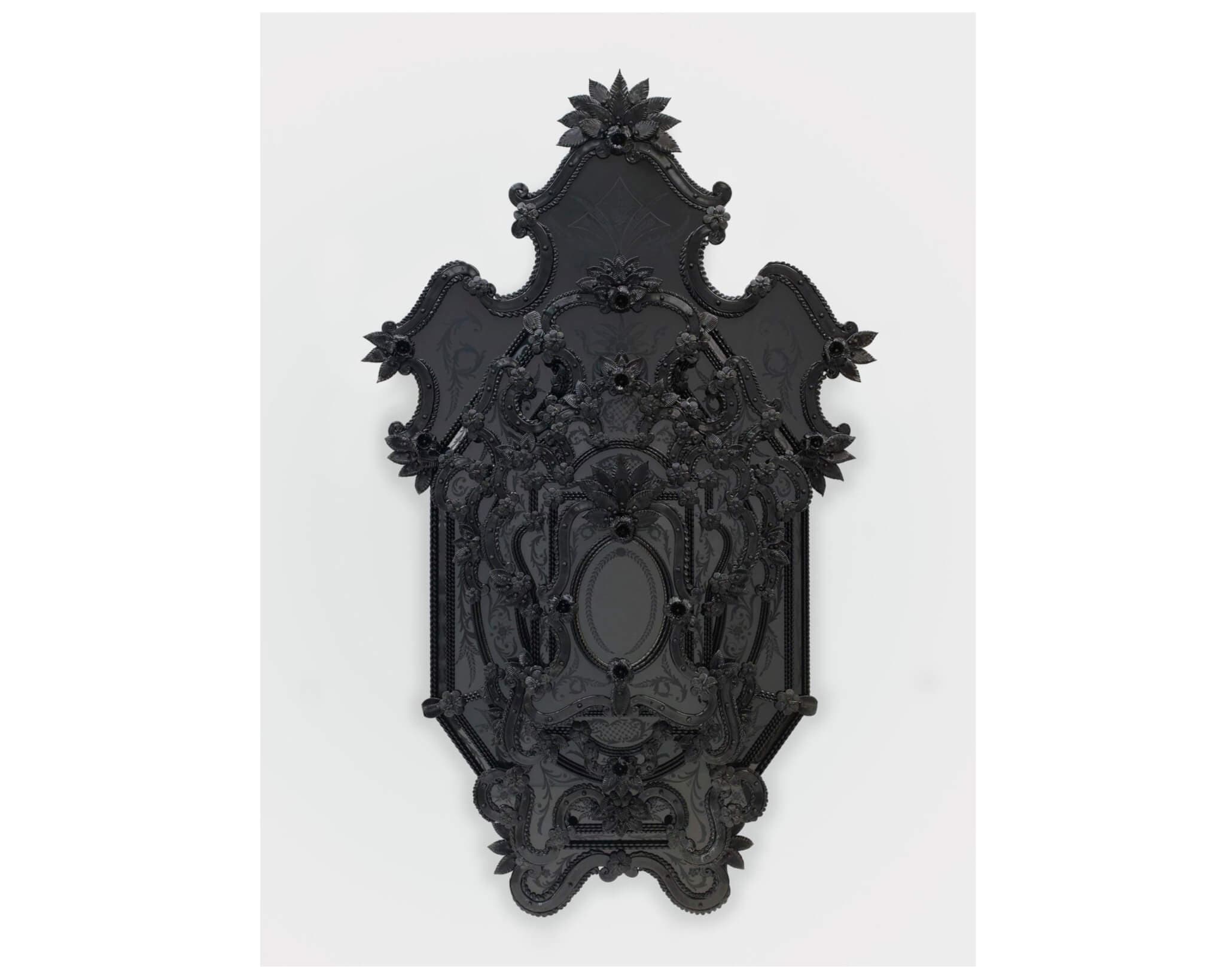
Two smaller, elaborately layered black mirrors—Iago’s Mirror (2009) and Mark (2009)—punctuate the first section of the show, demonstrating the glassmaking method Wilson has perfected. Prior to representing the United States in Venice, Wilson began studying glassblowing on the nearby Italian island of Murano—a place well known for its centuries-old glass craftsmanship—and conducting research on the African population in Venice as early as the fifteenth century. To create these dark mirrors, Wilson paints the back side of Murano glass panes black and then positions them variedly layered atop and gridded alongside one another. The reflection fractures across the multiplicity of the mirrors. Their blackness absorbs the light to create a darkened, beclouded image.
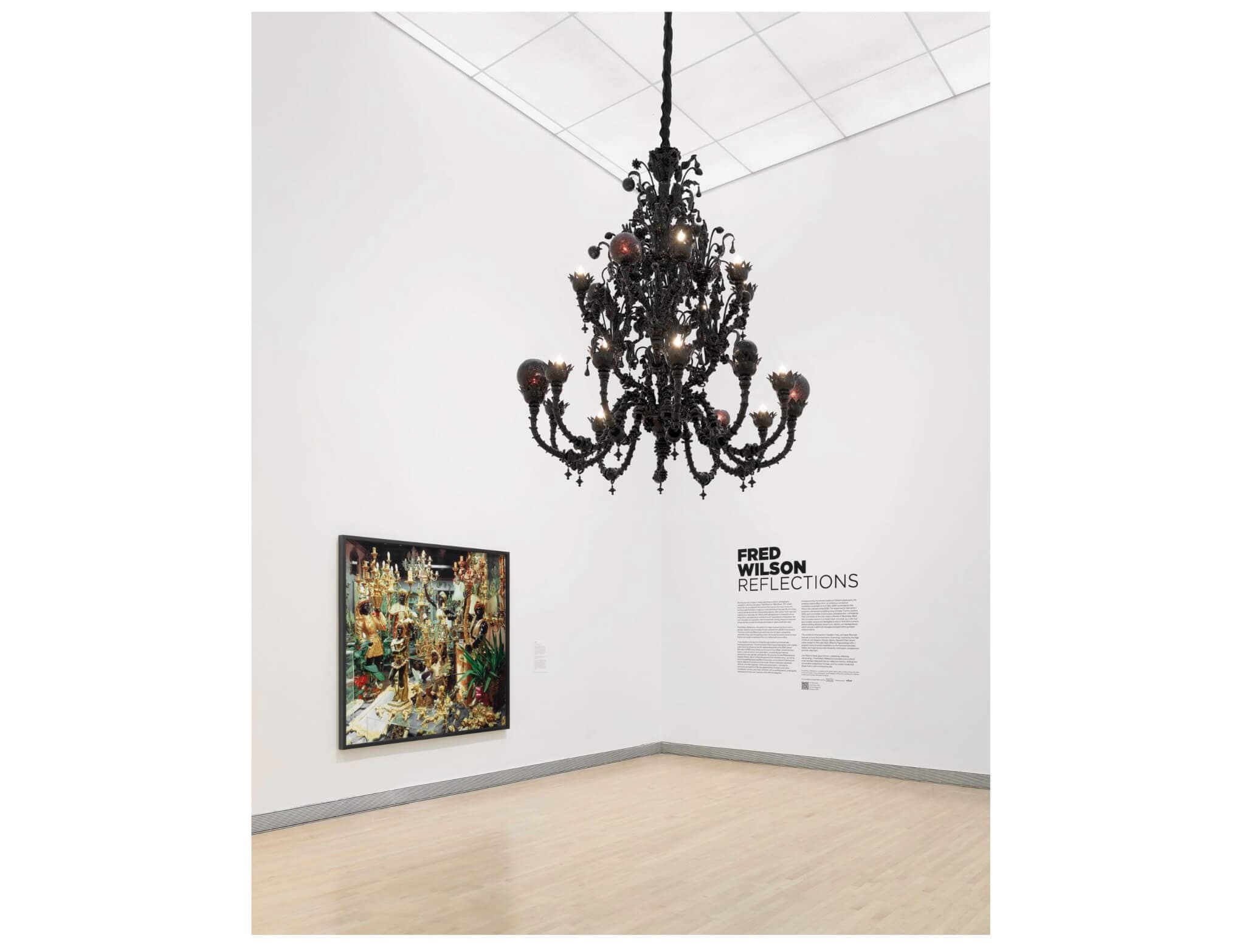
Three chandeliers hang overhead in this section. Much more than ornamental light sources, Wilson’s chandeliers manifest interconnected inquiries into Blackness and power from the Middle Ages to present, across fiction and reality, and in Venice and beyond. The blown glass, brass, and steel Eclipse (2017) examines the conflict and exchange between the Venetian and Ottoman empires, while No Way But This (2013) and Dramatis Personae (2022) return to Othello to address interracial marriage, power, and death. In the former black is all-encompassing and in the latter black is an accent within a predominantly white structure, yet blackness is integral to both. “No way but this” quotes Othello’s final words between killing his wife and himself. In Dramatis Personae both the ratio and the contrast between black and white amplify the racial dynamics of the play.
Wilson’s works in this section arose from his query of how African people are rendered in Venetian paintings and decorative arts of the seventeenth and eighteenth centuries (by Titian, Veronese, and Tiepolo, for example). North Africa, Europe, the Near East, and the Americas (2003) is a grid of four large color photographs. Each image offers a close crop of the four African male figures depicted within a larger marble and bronze 1669 monument, the tomb of Doge Giovanni Pesaro at Santa Maria Gloriosa dei Frari in Venice. The distress in each figure’s bulging white marble eyes is accentuated by the stark contrast with the black marble of their skin. While the tomb is indicative of enslavement during a specific point of conflict between the Venetian and Ottoman empires, Wilson recognizes the anguish of these four men as representative of Black people globally and titled the piece accordingly.
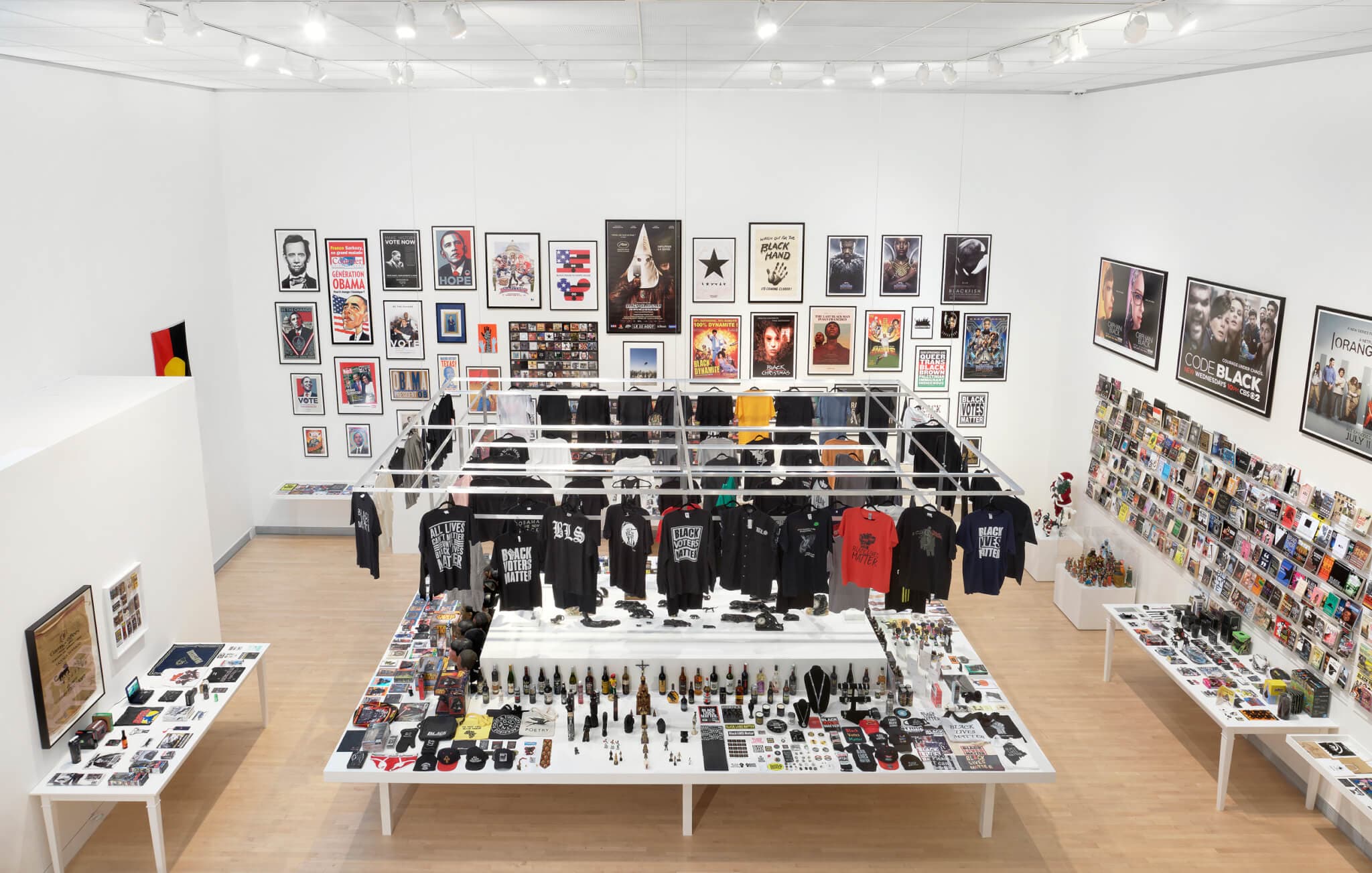
After this exploration of historic representation, Black Now! (2005–2025) jolted me into a contemporary and US-focused project. Dozens of T-shirts, most of them black, dangle from a high-hanging tiered rack in the center of the installation above a large display case. Several smaller vitrines line the walls—one is dedicated to Black Santa Claus figurines, another to the Black Panther Party, while others present greeting cards, masks, beauty products, toys, foods, liquors, cigarettes, and more, carefully grouped together by type. The walls exhibit hundreds of books, CDs, DVDs, and political and movie posters. The wall that cuts crosswise in the gallery sections off the installation, making the black objects on display at various levels feel all the more crowded and encircling. Coupled with the high density of objects and their placement in close proximity, the installation is intensely stimulating—something like a thrift store where everything is black.
Wilson began collecting objects that are black in color, name, or reference in 2005. The installation—composed of over 2,500 objects—does not propose to contain every kind of relevant object, but instead points to the ubiquity, constant use, and continuous extension of concepts of blackness. By arranging this variety of objects in the context of one another, Wilson makes a broader comment on the usages of Black across types of objects and ideas. The artist connects political figures like Barack Obama and Kamala Harris with the wild (and problematic) promises of self-tanning lotion.
Walking into the Black Now! section of the exhibit, my compulsive intrigue with all things Black and black was at once satisfied and exposed. Within it are all of the things, or the kinds of things, that catch and hold (even direct) my attention in everyday life. But instead of being scattered amid the rest of the quotidian, they are all together. No more than two steps through the section’s doorway, I stood with all but my eyes motionless for a few minutes. There is simply so much.
The installation has a linguistic element as well. Phrases printed on various objects and media make clear that there are endless uses and implications of blackness: Black Coffee, Black Out, Silver Black, Dark Black, Darker Than Black, Mr. Black, Black Swan, Black is Beautiful, Seduction in Black, Black Power, Black Gold, Black Shine, Blacklite, Black Cat, Ultimate Black, Black & Mild, Black Jack, Black Panther, Black Lives Matter, Black Hole, Black Love, Black Mama, Pitch Black, Black Magic, Black Music, Black Silk, Black Sugar, Black Tea, Black Pepper, Black Jesus, Black Death, Code Black, Black Barbie, Black Star, Baby Got Black. All together in a repetitive unison, the objects of this installation beg the question raised by soul singer Billy Paul’s 1972 song “Am I Black Enough For You?” The only plausible answer: Black is infinite.
Around the corner in a stairwell hang thirty-six paintings inspired by flags of Africa and the African Diaspora. Each one is denuded of its traditional vibrance, with only black shapes, stripes, and outlines rendered on raw canvas. This reimagining of the flags prioritizes their shapes and highlights the presence of black over all of the other colors. It leaves them reminiscent of a fresh coloring book that awaits color to distinguish each image. The symbols feel familiar yet not immediately intelligible.
Distilled to its saltire design, the Jamaican flag suddenly represents something other than the country’s lush landscape and the strength, creativity, and hope of its people. In the stairwell, I overheard a student mistake Wilson’s rendition of the Jamaican flag for the Confederate flag—a mistake one simply would not make if the green and gold or red, white, and blue were present. But the student’s error is not sheerly a misinterpretation of the work so much as a signal toward the importance of color. Wilson’s words on the wall at the bottom of the steps read, “I feel the lack of color in the African Flag paintings expresses a feeling of loss—the loss of human potential in the wholesale theft and abuse of thousands of children and young adults abducted by slave traders.” While Wilson’s work visually addresses national flags, which would exclude the Confederacy, the African Diaspora in the American South remains relevant—by design. The artist calls attention to the design elements these flags have in common and effectively directs us to consider their intertwined histories.
From the balcony at the top of the stairwell, the tops of the chandeliers are visible and physically closer than they appear from below. For me, this viewpoint set my intrigue anew, inspiring me to double back and explore all of “Reflections” once more. By spanning the specificity of an underthought Black presence within the Venetian Empire to the wide reference to blackness across contemporary objects, Wilson affirms that blackness is everywhere, and it is ever-expanding.
“Fred Wilson: Reflections” is on view at the Rose Art Museum 415 South Street, Waltham, MA, through June 6, 2026.