It’s a three-hour drive to MASS MoCA from Salem, crisscrossing across multiple state highways and solitary roads from one end to the other of Massachusetts, my home state in a country I left for over a decade and recently returned to at what could be described as a suboptimal moment in American history, at least for someone of my demographic. I’ve been asked over the years what it feels like to move across the world to unfamiliar cities and where I really feel at home, but the truth might surprise. There are so many shades of belonging in any country between the land itself, its ideology, and the dreams of its people, but Trump’s recent anti-DEI orders only brought back echoes of growing up in Massachusetts as an outsider, in the only non-white family I knew in my hometown. It was these feelings that brought me to see the museum’s exhibition “Dirty & Disorderly: Contemporary Artists on Disgust,” which frames disgust as a historical means of othering marginalized groups.
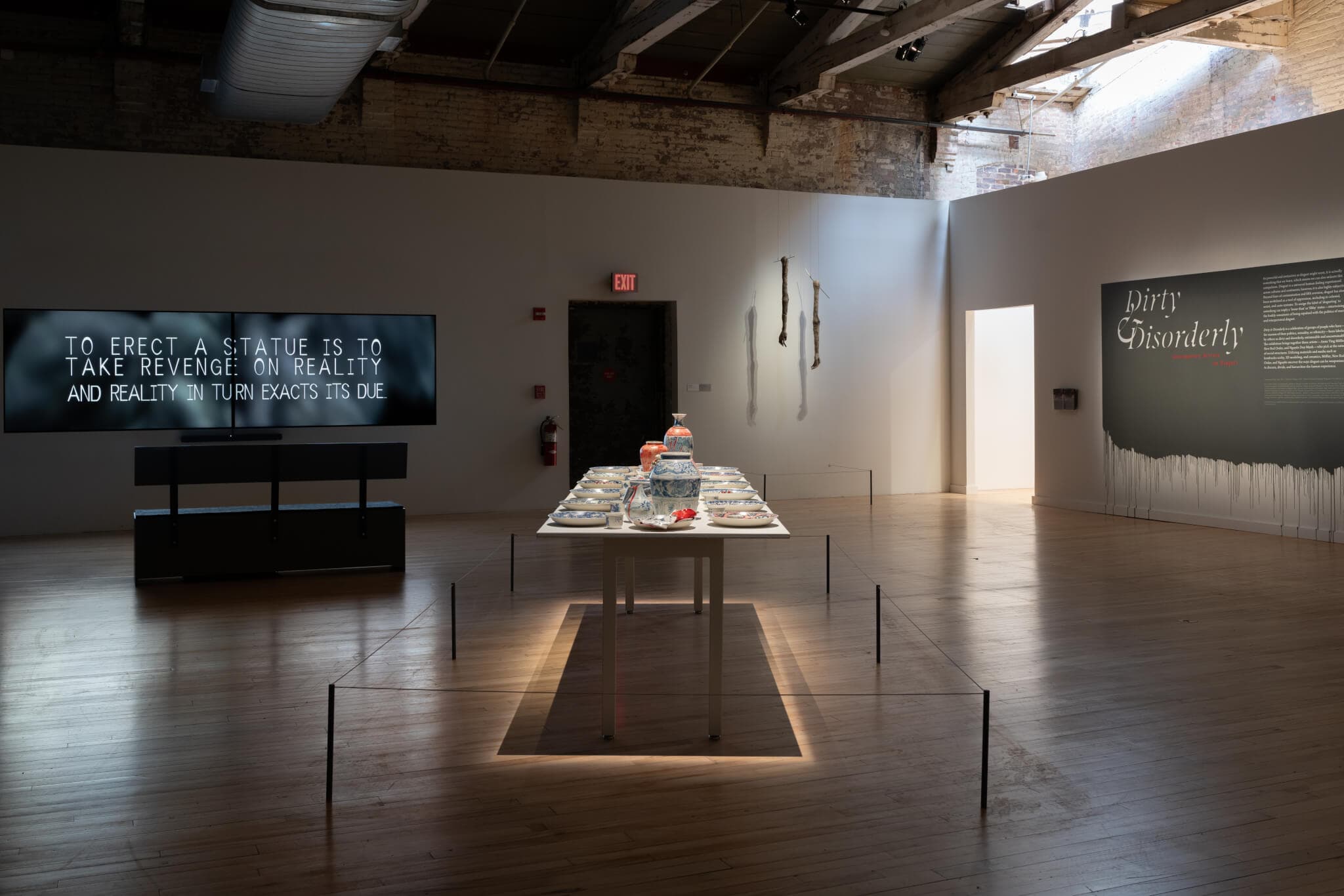
The museum is a maze of old factory buildings, and while some of the exhibitions are on a grand scale, others are tucked at the ends of hallways or are found through seemingly hidden doors. At a right-hand turn up one flight of stairs is a dimly lit room with high ceilings that modestly houses the four works in the exhibition. Diptych screens hang against the back wall playing New Red Order’s two-channel video Culture Capture: Crimes Against Reality (2020), the screens flashing between pictures and negatives of monuments, while to the right hang the gray-skinned humanoid arms of Anna Ting Möller’s Slut Station (2023).
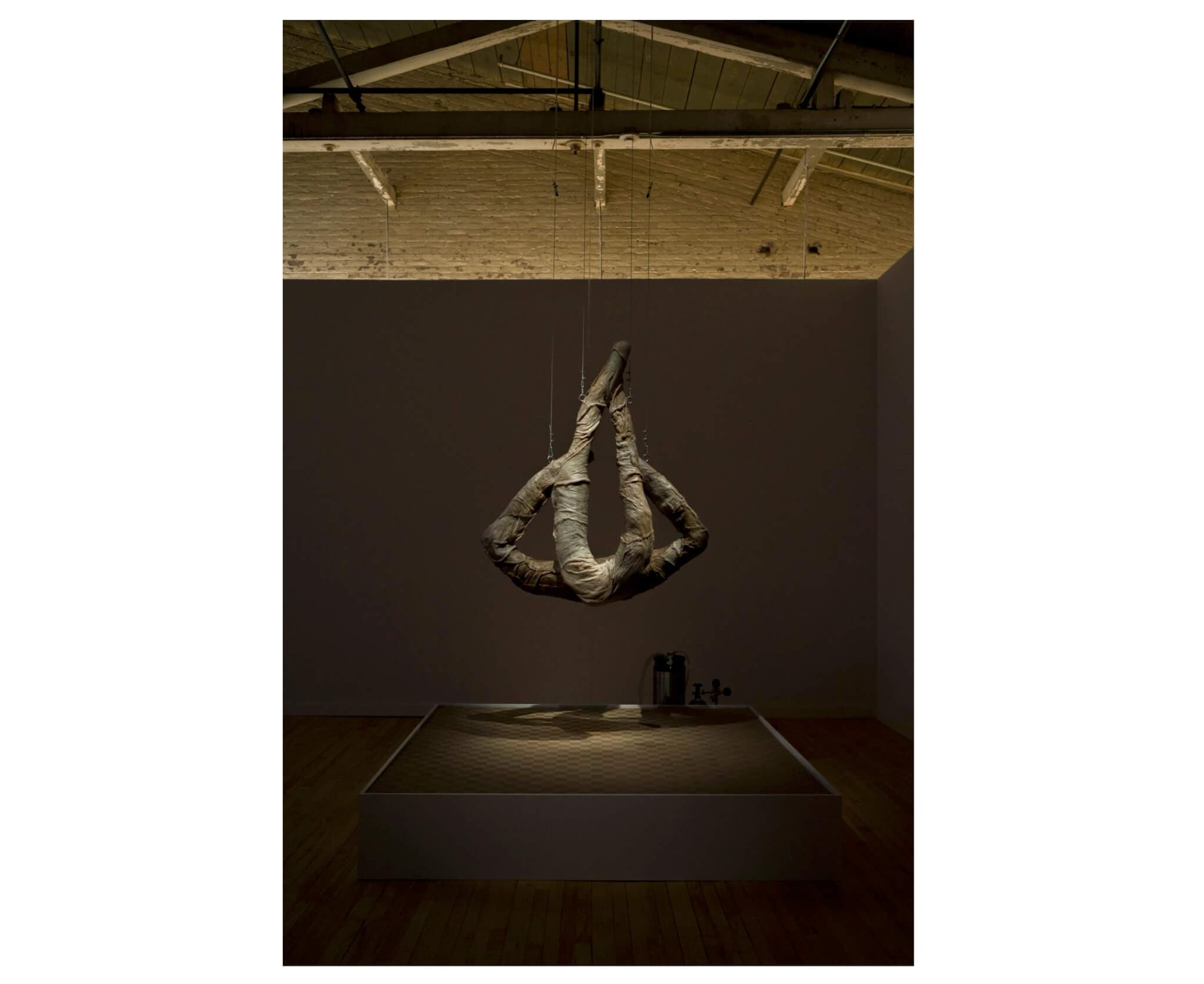
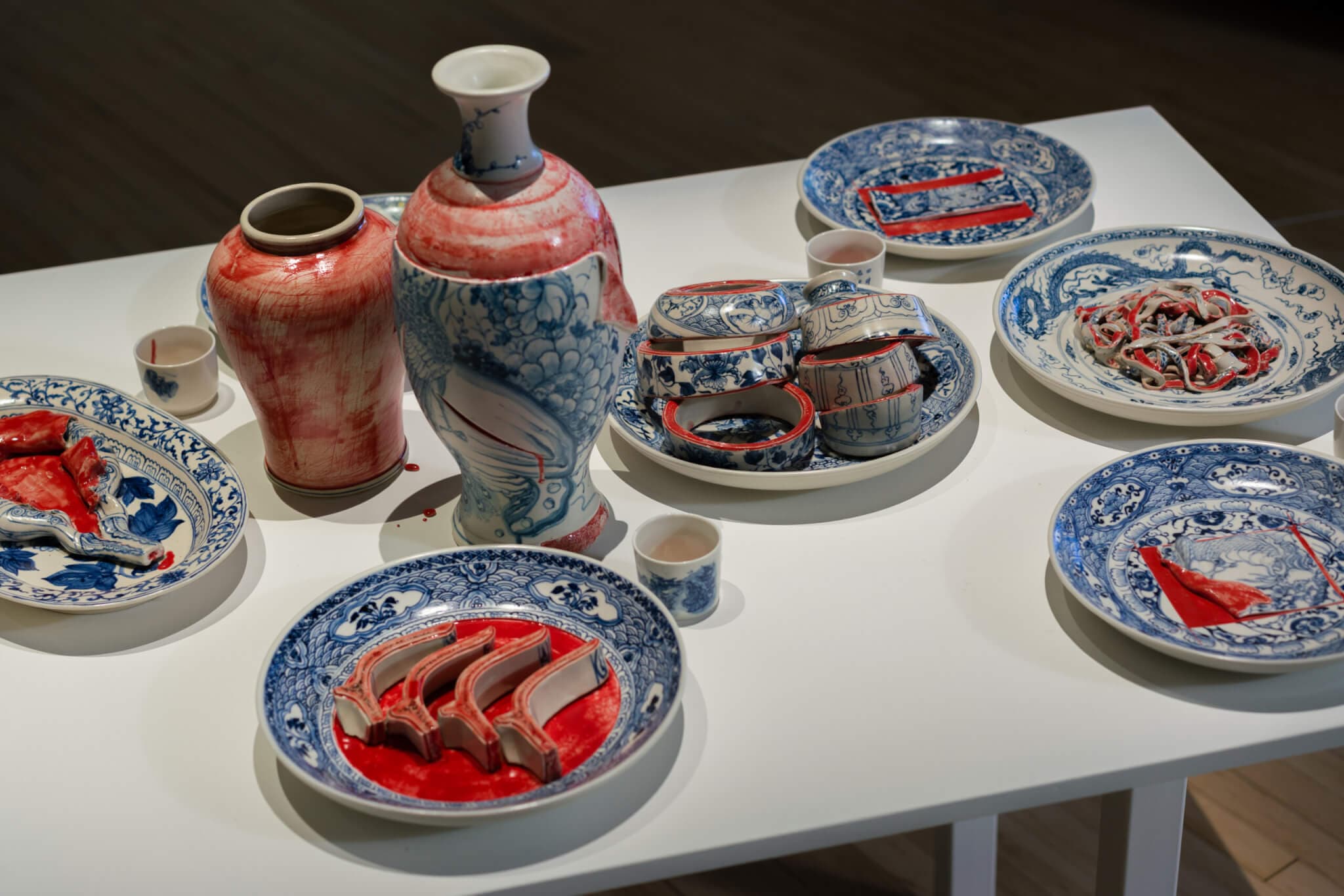
The artist’s new work commissioned for this exhibition by the museum, In Tandem (2025), was off view during my visit, swathed in plastic and hooked up to a silver canister like some alien life-form waiting to come to life. “Rehydrating,” according to one staff member, or rather, correcting the delicate balance of moisture needed to slowly dry the sculpture made of a symbiotic culture of bacteria and yeast, or scoby. Nguyễn Duy Mạnh’s Phách Lạc (2017–2023) is placed near the center of the room, a long table set with delicate blue-and-white porcelain ware that has been peeled, cut, and dissected to reveal bloody muscle beneath.
The exhibition text frames the show along colonial and political lines, and in doing so, blurs the separate contexts of each artist and their work. Yet in person, each piece is a moment of macabre but exquisite beauty and seems to have been chosen along aesthetic, rather than thematic, lines. MASS MoCA curatorial fellow Riley Yuen writes, “[Disgust] has often been weaponized as a tool of oppression, intertwining visceral disgust … with the politics of moral and physical disgust. … Disgust has been used to defend dogmas of racial purity, caste systems, colonialism, and patriarchy.” Contrary to what the exhibition text might imply, Mạnh’s Phách Lạcis not a commentary on the violence inflicted on colonized bodies but on the death of cultural heritage at the hand of industry. The title Phách Lạc, or “Lost Spirits,” refers to the idea that these cultural objects contain a kind of spirit or soul vulnerable to destruction. Mạnh’s work is as palpable as it is philosophical; the sculptures, which have the velvet, semi-matte texture of a classic Vietnamese glaze over porcelain, are adorned with droplets and lashings of glistening crimson “blood” and are entrancing, so much so that I found myself circling the table repeatedly, unable to tear myself away.
Similarly, though the exhibition text informs us that Möller’s flesh-like sculptures embody “the impermanence and malleability of relationships,” these prescribed interpretations seem extraneous next to the physical experience of the work. Möller’s flesh-like forms are made with living scoby that bears an eerie resemblance to skin and slowly dries in what resembles stages of mummification; they make my own skin crawl in sympathy. In an interview with CanvasRebel, Möller, a Chinese Swedish artist living and working in New York, describes their work with kombucha scoby as focused on “corporeal potential.” Though their work with scoby has the feel of a true origin story—they were gifted the culture on an unsuccessful trip to China to find their birth mother—they do not draw a clear line between their birth heritage and their work. Instead, they speak most of the transience of the material and its forms, and occasionally about the kombucha “mother,” or original culture, from which all works are made.
New Red Order’s Culture Capture: Crimes Against Reality is the only work that truly falls under this theme of decolonization. The video revolves around two public sculptures made by James Earle Fraser that have controversial depictions of Indigenous Americans. Equestrian Statue of Theodore Roosevelt (1939), which formerly stood outside of the American Museum of Natural History in New York City, shows the eponymous former president astride a horse flanked by an Indigenous American man and sub-Saharan African man with lowered eyes. When it was removed in 2022 after many attempts to add context were deemed insufficient, it was, in the words of the museum’s president at the time, Ellen V. Futter, because of the statue’s “hierarchical composition.” The second sculpture, End of the Trail (1894), shows an Indigenous American man drooping from exhaustion on an equally weary horse, his spear pointing toward the ground. Made by Fraser as a commentary on the genocide and relocation of Indigenous peoples at the hands of European and American settlers, it has come under controversy more recently for perpetuating the myth of the “Vanishing Indian,” defined according to Harvard University’s Pluralism Project as “noble, brave, and yet destined to sacrifice both freedom and land for the making of America.” In the video, the bronze cast of End of the Trail appears on an island and begins to disintegrate, crashing into the water. Equestrian Statue of Theodore Roosevelt appears as it did in real life, its dark bronze dull and faintly green before it, too, begins to change, glowing with ember-like flecks of red and orange before succumbing fully to its new state and becoming a digitized amalgamation of flesh. It does not stay long in the form of the statue. It splits and multiplies, pulsating, glossy, crystalized—an entirely new being.
Though the works and their disparate themes are unsuccessfully combined under the umbrella of political and social marginalization, the unified physicality of the combined works is irreproachably in sync, coming together to create a kind of sensory polyphony of living, necrotic, and virtual flesh that disconcerts even as it draws the viewer closer. The genuine affinity of the aesthetic elements left me questioning why the curators attempted to force the exhibition into decolonial terminology at all.
Art is as much the context in which it is received as the work itself. This exhibition reflects recent criticism in the art world on inclusivity as a curatorial direction and the categorization of marginalized groups, which sometimes borders on being as broad as anyone besides white, cis men. Last year’s Venice Biennale, titled “Foreigners Everywhere,” for example, was criticized for combining an entire host of BIPOC, queer, Global South, and refugee artists in a show that was inclusive to the point of being problematic. It’s an assertion I can confirm personally after over an hour of sitting inside the circular room of the Disobedience Archive, where videos were played next to one another like a hundred channels streaming from different places and time periods. The video archive focused on two general themes, or macrosections, for the Biennale, Diaspora Activism and Gender Disobedience, but there was something disturbing about watching Sweatmother’s Protest and Demo Documentation in London (2019–2023) alongside Khaled Jarrar’s Notes on Displacement (2022). In the first, young trans people staged a fashion show outside of London’s Somerset House during Fashion Week 2019 to demand visibility, catwalking the streets with pride. In the second, a family of Syrian refugees sat on the floor of a trailer, a small, unfurnished box without windows. In a previous scene, others in the refugee camp complained about a lack of edible food, as many of the donated supplies had gone bad; in this scene they shared a single can of food, passing it around slowly. Both of these videos contained important stories, but they could not be conflated by the broad assertion that “you are always, truly, deep down inside, a foreigner,” one of the main quotes and themes of the Biennale.
Perhaps one solution to both of these exhibitions and possibly to inclusivity as a whole is to temper our good intentions with specificity—after all, isn’t lumping everyone into broad categories another form of erasure? The artists in “Dirty & Disorderly” are all technically BIPOC, but they come from very different backgrounds. New Red Order is headed by Indigenous American artists Adam Khalil, Zack Khalil, and Jackson Polys, and in this exhibition they present a political activist context that is rooted in American history and culture. Möller, a Chinese-born Stockholm transplant now living in New York, notably does not utilize the same vocabulary or context of many diasporic Asian American artists; their work must be taken in its own measure. Finally, Mạnh’s work can best be understood from the perspective of Vietnamese culture, which is deeply rooted in spirituality. Though Vietnam is technically a country in the Global South, its economic star has never shone brighter. Whatever tragic story still lives in the minds of the West has very little bearing on its reality today, and that is why broad references to colonialism in contemporary Vietnamese art often feel out of touch.
This is not to say that the exhibition’s focus on disgust is entirely misplaced. Who could forget Trump’s presidential debate assertion that Haitian migrants in Ohio were stealing and eating pets? In this iteration of America, it feels as if there is endless capacity for physical and moral disgust. From the right, grotesque and unfounded claims about the bodies and criminality of transgender people, migrants, and refugees. From the left, a knee-jerk moral revulsion that spawned the cancel culture of the 2010s but failed to meaningfully address social issues such as racism and sexism by othering those across the aisle. In this impasse of exclusion, it’s possible that the most radical or “disorderly” thing to do is to put aside our distaste and start having those hard but necessary conversations with those outside of our chosen beliefs.
“Dirty & Disorderly” is on view at MASS MoCA Way, North Adams, MA, through January 4, 2026.